Cardiac Rehabilitation
The Challenge
Cardiovascular disease is the leading cause of death and disability in the UK.
Cardiac rehabilitation (CR) is a personalised program of supervised exercise, education, and counselling. It is a clinically proven, NICE recommended intervention which significantly reduces mortality, hospital readmissions, and improves quality of life for patients following a cardiac event.
Yet services are under severe strain: referral rates remain lower than national targets, waiting lists are growing, and delivery teams face mounting administrative burden.
People in the UK living
with cardiovascular
disease
Of eligible patients
never access cardiac
rehabilitation
Annual NHS cost
attributable to
cardiovascular disease
Deliver standardised group rehab programmes
Supervised exercise groups
The backbone of every CR programme. The warm-up and cool-down are genuinely group activities; the circuit element is individualised within the group setting. These are the highest-frequency group touchpoints and the ones where scheduling and DNA reduction have the most direct impact.
Cardiovascular education groups
Standard education session topics include anatomy and disease pathophysiology, anxiety and depression, self-management, managing breathlessness and symptoms, medications and treatments, managing exacerbations, nutrition, pacing, and smoking cessation.
Psychological support and relaxation groups
Psychological support and relaxation are core components of UK cardiac rehabilitation (CR) programmes. Typically delivered via psychoeducational workshops and group-based training, they teach patients diaphragmatic breathing, progressive muscle relaxation, and coping techniques to alleviate post-event anxiety, reduce stress, and improve long-term cardiovascular recovery
Heart failure specialist groups
Heart failure specialist groups in cardiac rehabilitation (CR) integrate specialist nurses, physiotherapists, and dieticians to provide tailored exercise, medication titration, and education
Return to work groups
Assign OTs to run specific sessions around occupational rehabilitation: managing symptoms at work, graded return to activity, and communicating with employers.
Your custom groups
The groups above are just a few examples you can configure in autonom-e. Alternatively, you can create your own groups, appointments and associated resources to assign as many staff and patients as needed!
How group therapy can help
A single clinician delivering an 8-week virtual group therapy programme to 10 patients generates the same throughput as 80 individual appointments — without proportional cost increases or the need to travel.
The challenge is with coordination: scheduling cohorts, capturing PROMs across groups, managing reminders, and reporting outcomes at the service level.
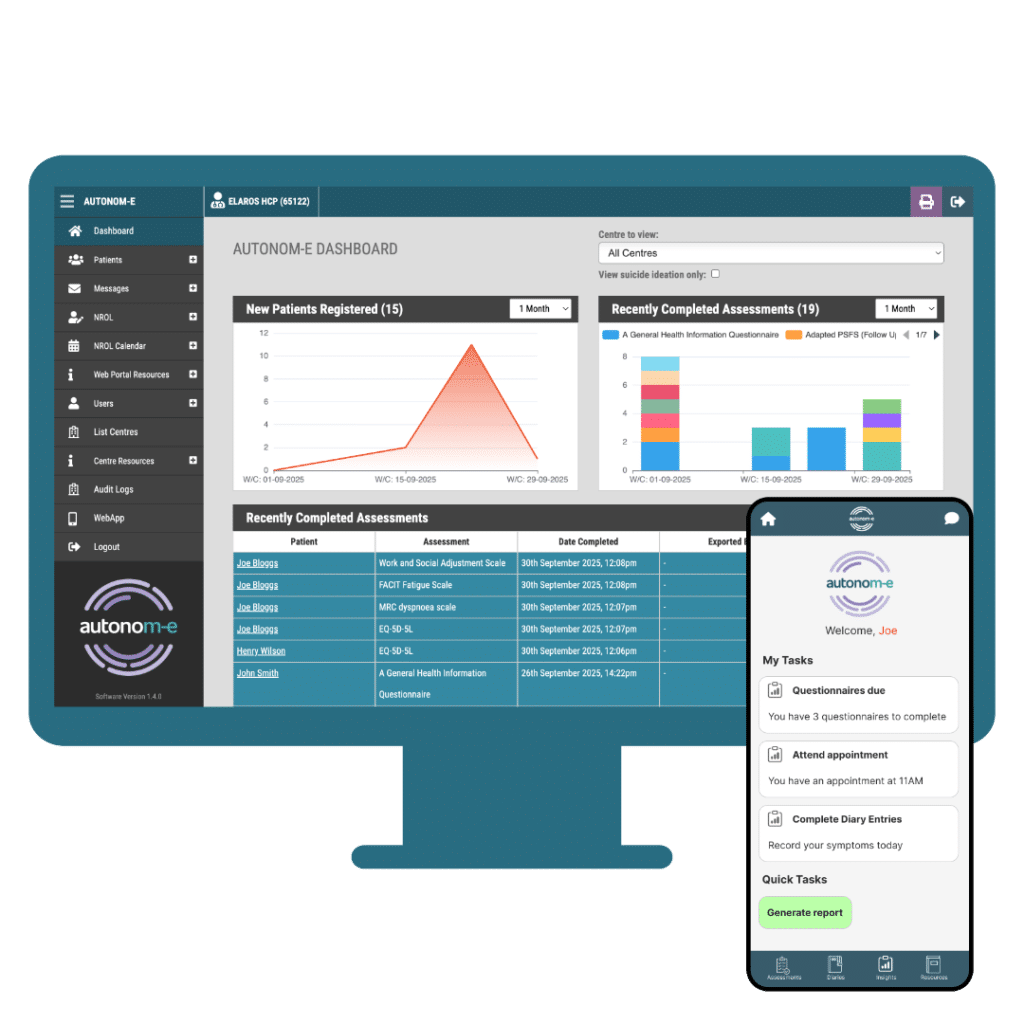
Autonom-e provides the digital infrastructure that makes group therapy possible and scalable whilst reducing administrative burden, improving workforce utilisation and the patient experience.
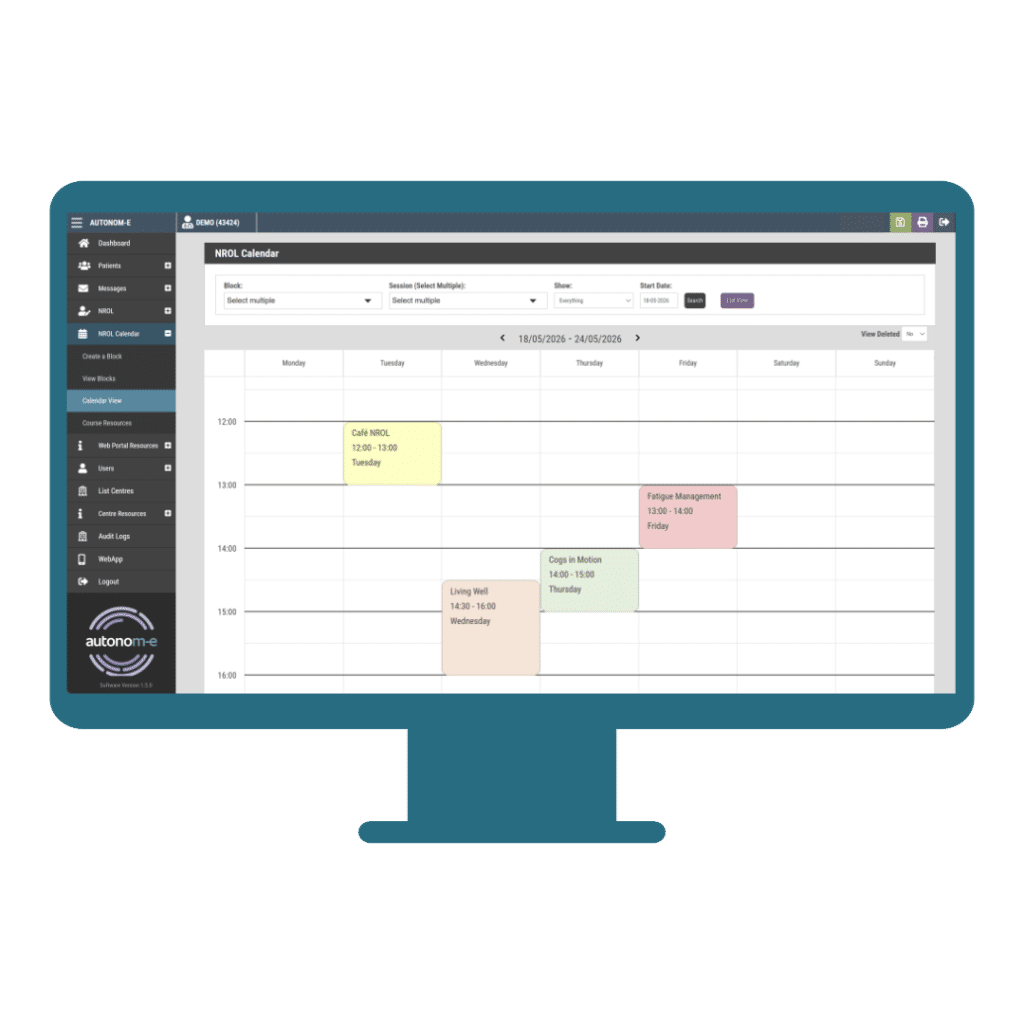
Each session is scheduled, patients are automatically notified, PROMs are captured before and after each block, and outcomes are available in real time on the clinician dashboard.
Co-ordinating group therapy
Referral & Triage
Cohort assignment
Session scheduling
Automated reminders
Monitoring & review
Discharge & PIFU
Platform Features for group therapy services
Streamlined referral, assessment & triage
Patients can be referred from primary care, from external referring teams across a region, or via self-referral if enabled.
Referrals sent directly to autonom-e are encrypted at rest and in transit.
Entry assessments can be configured for different pathways to support initial triage and stratification into group cohorts.
Pre- and post-programme PROM capture to measure group-level and individual outcomes.
Group scheduling and cohort management
Create blocks of weekly group therapy sessions in advance from the clinical dashboard. Triage patients and assign to appropriate groups based on external referral recommendations.
Assign facilitating staff & tech support to each session. Sessions automatically push to each patient’s app with date, time, format, and joining instructions.
Reporting and service analytics
Automated PROM dispatch on entry and exit of therapy programmes collects outcomes to demonstrate change in health.
Recorded attendance allows staff to monitor uptake, throughput, DNA rates, and ROI for every hour of staff time spent delivering care.
Cohort-level outcomes dashboards showing improvement trends across group programmes. Individual patient progress visible within the group context. Export clinical reports directly to electronic health records.
Service-level data to support commissioning decisions, business cases, and NICE compliance reporting. Cost-effectiveness modelling data to demonstrate value to ICB commissioners.
Self-management and resources
Configurable digital resource library aligned to each group programme (condition-specific written, audio, and video content). Signposting to peer support, local services, and third-party providers within the app.
Translatable resources supporting diverse and multilingual populations. eDiary tools for symptom tracking, goal-setting, and exertion monitoring between sessions
Why choose autonom-e for cardiac rehabilitation?
01
Configurable to your pathway
Tailor group programme structures, eligibility criteria, PROM bundles, session formats, resources, and branding to match your service design – without expensive bespoke development.
02
Reduces administrative burden
Appointment scheduling, automated PROM capture eliminate paper, postage, and manual data entry. 1,250+ estimated clinical admin hours saved each year in Lancashire.
03
Reduces waiting times
Group therapy enables services to multiply appointment availability with the same staff time, allowing for waiting times to be cut and pre-appointment administrative tasks to be automated.
04
Scalable across organisationstions
Deploy autonom-e in a single-service or multi-site deployments across ICBs, NHS Trusts, community providers, and VCSE organisations – with each site maintaining its own configuration and branding.
05
Evidence ready
Capture group-level and individual outcomes data to evaluate service impact, demonstrate cost-effectiveness to commissioners, and support research bids or NICE submissions.
06
Improved health equity
Increased rehab provision and workforce utilisation enables patients to receive more intensive and multi-disciplinary care remotely from home, without the need for travel.
Outcomes from our platform
90%
reduction in time spent supporting screening
83%
Reduction in clinician time on virtual assessments (Airedale & Bradford)
96%
PROM completion rate across patient cohorts (Airedale & Bradford)
Enter Your Details Below to Access Our Group Therapy Brochures Today!
Contact Us
For general enquiries, sales and technical support, get in touch!
Follow us: