Neuro Rehabilitation
OnLine (NROL): Case Study
Context
Across the NHS, stroke rehabilitation services face significant challenges: increasing demand, workforce constraints, variation in access, and limited capacity to deliver therapy intensity aligned with national guidance. Repeated pilots have demonstrated promise but often fail to translate into sustainable, commissioned services.
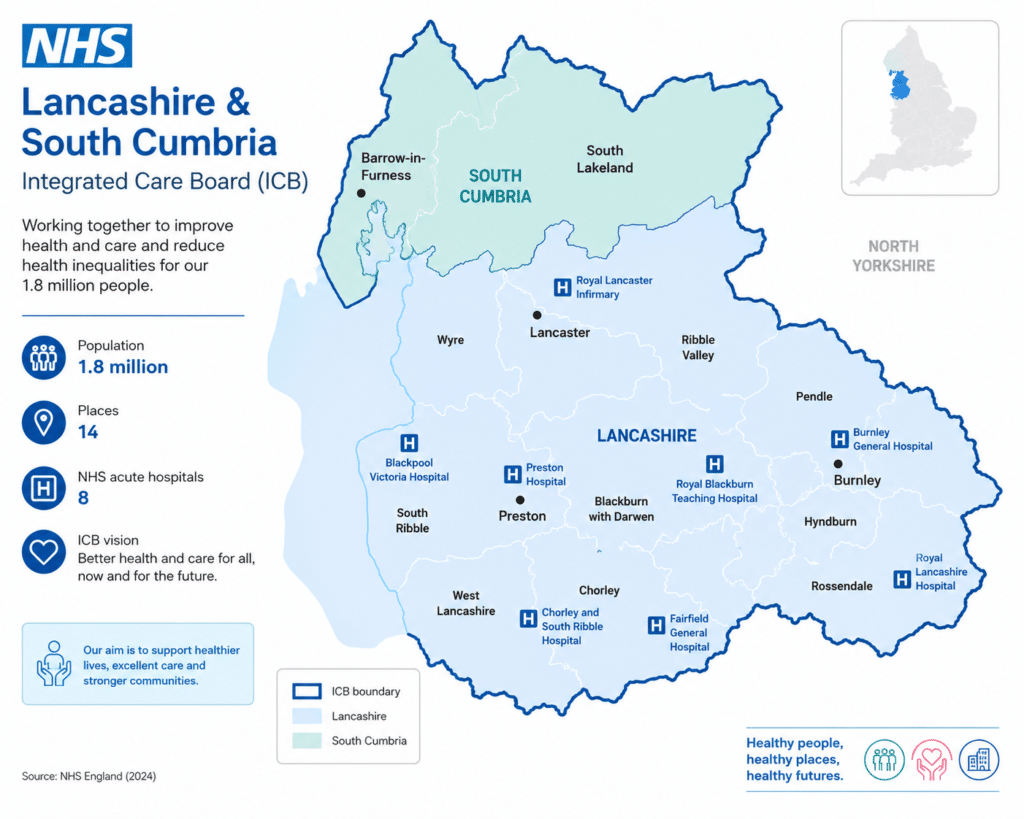
Neuro Rehabilitation Online (NROL) is one of the exceptions. Designed, iterated and piloted by local NHS teams and academic partners across Lancashire & South Cumbria (L&SC) over five years, NROL secured Small Business Research Initiative (SBRI) funding in 2025 to scale from single-trust pilots into a regional, digitally enabled group rehabilitation service spanning Lancashire & South Cumbria, with adoption now extending into the Cheshire & Merseyside ICB footprint.
ELAROS joined the NROL consortium as the digital delivery partner on the SBRI project, adapting its existing autonom-e platform to build additional group scheduling and role-based access control functionality needed to deliver NROL safely and securely across multiple participating NHS organisations.
Our case study builds on two case studies documented by Health Innovation North West Coast on NROL below – from the perspective of the digital infrastructure behind it, and what that means for delivery teams and commissioners considering a similar model for their own population.
Recognition:
The NROL model
NROL is a digitally enabled, group-based neuro-rehabilitation service designed to increase access to evidence-based rehabilitation for people following stroke and other neurological conditions.
NROL delivers real‑time, clinician‑led group therapy sessions using video‑based technology. Sessions are delivered by a multidisciplinary rehabilitation workforce and are offered as a structured programme (typically in blocks), complementing existing face‑to‑face rehabilitation rather than replacing it. It is designed to increase access to intensive rehabilitation, reduce travel and capacity pressures, and support equitable, sustainable delivery as part of routine NHS care.
What NROL delivers
- A virtual, 6-week structured multi-disciplinary group rehabilitation programme for patients with acquired neurological conditions, co-ordinated by an operational team on behalf of the region.
- Delivery by 7 delivery teams across 4 NHS Trusts in Lancashire & South Cumbria, with the pathway being lifted and shifted into Cheshire & Merseyside ICB.
- Structured weekly sessions covering fatigue management, cognitive rehabilitation, communication, physical function, emotional wellbeing and self-management.
- Access to increased therapy intensity from home, which would not otherwise be available on a 1:1 basis due to staff constraints.
- Increased workforce utilisation by leveraging specialist skills across a region rather than within a single team.
- The blueprint for regional rehabilitation service provision in new clinical areas such as cardiac, pulmonary, frailty and vocational rehabilitation services.
Outcomes and system value
Patient outcomes and access
NROL provides more intensive therapy to patients, leading to positive feedback and improved recovery. The online model significantly enhances accessibility, particularly for patients in diverse geographical areas.
Efficiency and resource optimisation
The online delivery model reduces clinician travel time, freeing up valuable clinical hours that can be reallocated to patient care. This efficiency is crucial in a resource-constrained environment.
Environmental sustainability
Over 37,500 miles and 1,250 driving hours avoided annually by therapists not travelling to and from each patient for NROL sessions.
Scalability and transferability
The NROL model is not limited to stroke rehabilitation. It has the potential to be “lifted and shifted” for other rehabilitation challenges such as frailty, heart failure, COPD and arthritis. This broad applicability makes it a compelling blueprint for future innovations.
Cost-effectiveness
The model has been shown to be significantly more cost-effective than traditional approaches, being “five times cheaper” while seeing more patients.
Strong clinical leadership and collaboration
The project’s success is deeply rooted in strong clinical leadership and effective cross-organisational collaboration. This collaborative spirit has fostered trust, clear communication and a shared vision, overcoming potential challenges like diverging views post-funding.
Evidence-based approach
Continuous evaluation, data collection and peer-reviewed reporting, including patient stories and feedback, provide robust evidence of the programme’s effectiveness and credibility.
How autonom-e powers NROL

Autonom-e provides the digital infrastructure to streamline NROL in Lancashire & South Cumbria — referrals, scheduling, governance and reporting layer that lets a 6-week, multi-disciplinary group programme run reliably across several Trusts at once. Its core capabilities include:
- Capturing external referrals
- Assessment & triage
- Group programme scheduling
- Remote monitoring and self-management
- Clinical reporting & analytics for SSNAP, BSPRM, and service audit
- A unified digital platform for participating teams
Outcomes in
Lancashire & South Cumbria
- 1,250+ administrative estimated hours saved per annum compared to separate commissioned services
- 3.7X ROI per annum for Lancashire & South Cumbria's deployment with 7 delivery teams
- 35% more patients expected to be seen in the first year following digital implementation
- Patients reporting improved physical recovery and better well-being
- 89% of patients felt NROL sessions were an important part of their rehab
- 94% rated NROL good or very good
- 89% felt joining online was easy
- 86% of NHS staff rated their experience of using ELAROS' platform as 4-5 stars
- 47,311 miles / year estimated saving in avoided driving distance
- 1,658 hours / year estimated saving in avoided driving time
- £27,913 / year estimated saving in avoided mileage cost
- 15,213 kgCO2e/year savings in avoided carbon emissions
Testimonials
“We are delighted to see NROL awarded this [SBRI] funding. The programme has already delivered remarkable outcomes for patients and this funding will help us provide even more support for those in need. It’s essential for stroke survivors to know that they can regain control of their recovery journey and NROL plays a vital role in empowering them”.
Jenny Clarke, CEO of SameYou
“Since adoption, people with Long COVID have their initial screening three weeks
faster on average, meaning they are triaged and added to the waiting list 3 weeks
sooner. Administration report a 90% reduction in time spent supporting screening.
Clinicians have a 50% reduction in the time taken to triage each person”.
NHS Lanarkshire Health Board
“The app was so straightforward and easy to use, probably one of the easiest apps I’ve had to use. Everything is pretty self explanatory”.
Patient supported through NROL
“I think it’s quite a clean looking interface. It’s in rows. I can see when all my appointments are easily”.
Patient supported through NROL
“It’s laid out well and easy to find what you’re looking for”.
Patient supported through NROL
“The knowledge and information through the app is helpful”.
Patient supported through NROL
“I’m not very tech…but that’s (the app) simple to do”.
Patient with cognitive difficulties supported through NROL
“The app is fairly easy and straightforward to use and means I can see the group sessions I am running and which patients are in the session much quicker than using the old spreadsheet and filters system”.
NROL Therapist in Lancashire & South Cumbria
“Training demonstrated useful features, such as finding info for referring therapist/trust as a point of contact, if the treating SLTs require feedback on patient presentation in group therapy”.
NROL Therapist in Lancashire & South Cumbria
“The app has been a game-changer, reducing the patient’s waiting time massively”.
Cambridge & Peterborough NHS Foundation Trust
“Waiting times for first appointment reduced by at least 2 weeks”.
Cambridge & Peterborough NHS Foundation Trust
“Since adoption, people with Long COVID have their initial screening three weeks faster, on average, meaning they are triaged and added to the waiting list 3 weeks sooner”.
NHS Lanarkshire Health Board
“Clinicians have easy access to questionnaires and summary reports with a 50% reduction in the time taken to triage each person”.
NHS Lanarkshire Health Board
Case Studies
Enter Your Details Below
to Access Our Brochures Today!
Contact Us
Teams interested in adopting the NROL model can contact Adam Partington, NROL operational lead, at adam.partington@elht.nhs.uk
Follow us: